Required pull = (GVW × rolling-resistance coef + GVW × sin(incline)) × 1.25 safety factor
  (× 1.2 more if a wheel/hub is damaged and dragging)
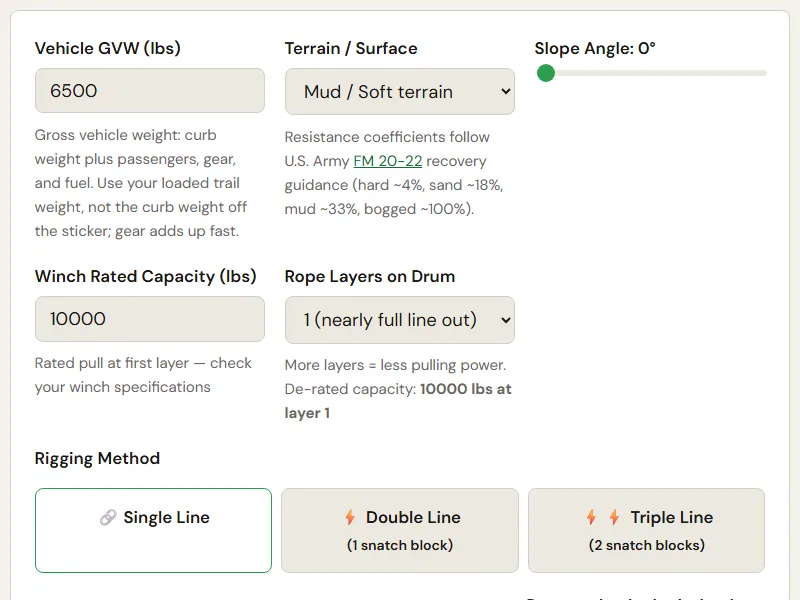
Effective pull = winch rating × 0.87^(drum layers − 1) × rigging multiplier
  rigging multiplier: single 1.0 · double (1 snatch block) 1.8 · triple 2.4
When a vehicle gets stuck, the winch must overcome two primary forces: rolling resistance and grade resistance. Rolling resistance is determined by the terrain: the U.S. Army FM 20-22 field manual documents ground resistance coefficients ranging from about 4% on hard pavement and ~18% in soft sand up to nearly 100% for a vehicle bogged to the chassis in soft mud. Multiply your vehicle's gross weight by that coefficient and you have the baseline pull force required to move the vehicle on flat ground.
The 1.25× multiplier is this calculator's planning allowance, not an SAE certification or a guarantee against overload. Actual resistance can exceed this estimate, particularly when a vehicle is stuck by suction or an obstacle. A static pull estimate cannot establish a safe shock load. Follow the winch manufacturer's operating instructions and reassess the recovery if the vehicle does not move.
Snatch blocks create mechanical advantage by splitting the load across both legs of the rope. A single snatch block in double-line configuration theoretically doubles pull force, but rope angle and pulley friction reduce real-world efficiency to roughly 1.8×. Two snatch blocks (triple-line) yield approximately 2.4× effective pull. However, there is a critical trade-off: the anchor point in double-line rigging experiences nearly twice the winch load, because both rope legs pull against the anchor. A tree saver strap rated for 8,000 lbs may fail when your 10,000-lb winch is rigged double-line to it.
Drum layer de-rating is one of the most overlooked factors in winch selection. As rope accumulates on the drum, the effective drum radius increases, which reduces torque advantage at the drum face. The result is approximately a 10–13% reduction in rated pull per additional layer. A winch rated at 10,000 lbs on the first layer delivers roughly 8,700 lbs on layer 2, 7,600 lbs on layer 3, and 6,600 lbs on layer 4. This is why the standard industry recommendation is to spool out most of the rope before winching: keep fewer layers on the drum for maximum pulling power.
The industry standard rating for winches is measured with a single layer of wire rope on the drum, at zero incline, on a hard surface. This means a 10,000-lb rated winch will rarely deliver 10,000 lbs in a real recovery. Understanding drum layers, terrain coefficients, and rigging multipliers together gives you a realistic picture of what your winch can actually do when you need it most.
Synthetic rope is lighter than steel cable, but it must not be treated as recoil-free. WARN's rope guidance notes that steel stores more potential energy and is less prone to abrasion; both types require safe winching techniques. Inspect the rope before use and protect synthetic rope from abrasive surfaces. Wear heavy leather gloves when handling either type, and follow WARN's basic winching guide for safe positioning and operation.